« Isatis tinctoria » : différence entre les versions
Mise à jour le Fri082015 |
Aucun résumé des modifications |
||
| (21 versions intermédiaires par le même utilisateur non affichées) | |||
| Ligne 1 : | Ligne 1 : | ||
{{Page espèce (plante à graines) | {{Page espèce (plante à graines) | ||
|image = | |image = Isatis tinctoria habitus.jpg | ||
|légende = | |légende = plante en fleurs | ||
|auteur = | |auteur = L. | ||
|ordre = | |ordre = Brassicales | ||
|famille = | |famille = Brassicaceae | ||
|genre = | |genre = Isatis | ||
|nb chromosomes = 2n = | |nb chromosomes = 2n = | ||
|origine = | |origine = Méditerranée, Europe,<br>Sibérie au Japon | ||
|statut = sauvage | |statut = sauvage, cultivé, naturalisé | ||
|français = '''pastel''' ; gaude | |||
|anglais = '''woad''' | |||
}}{{Encadré | |||
|color=lightgreen | |||
|titre=Résumé des usages | |||
|texte=*feuilles fermentées : teinture bleu indigo | |||
}} | }} | ||
== Description == | |||
<gallery mode="packed"> | |||
File:Isatis tinctoria.JPG|jeunes feuilles utilisées | |||
File:歐洲菘藍 Isatis tinctoria -比利時國家植物園 Belgium National Botanic Garden- (9216101624).jpg|fleurs | |||
File:Isatis tinctoria fruits.jpg|fruits | |||
File:Isatis tinctoria MHNT.BOT.2011.3.12.jpg|fruits (Museum de Toulouse) | |||
</gallery> | |||
*herbacée bisannuelle atteignant 1,5 m de haut | |||
*feuilles entières bleuâtres | |||
*grande panicule de fleurs jaune vif | |||
*fruits : siliques courtes et plates | |||
== Noms populaires == | == Noms populaires == | ||
{| class="wikitable" style="width:100%;" | |||
| français | |||
| pastel, guède | |||
|- | |||
| anglais | |||
| woad | |||
|- | |||
| allemand | |||
| Waid | |||
|- | |||
| néerlandais | |||
| wede | |||
|- | |||
| italien | |||
| guado, gualdo | |||
|- | |||
| espagnol | |||
| yerba pastel | |||
|- | |||
| catalan | |||
| glast, pastell, herba del pastell | |||
|- | |||
| portugais | |||
| pastel | |||
|} | |||
*Voir les noms dans toutes les [[:en:Isatis tinctoria (Common names)|langues européennes]] | |||
*'''Gaude''', '''woad''' et l'allemand '''Waid''' viennent du germanique. En français, la plante a été appelée '''pastel''' parce qu'on broie les feuilles en un '''pâte''' ; le mot est languedocien et dérive du latin '''pasta'''. | |||
== | == Classification == | ||
''Isatis tinctoria'' L. (1753) | |||
C'est une espèce très variable. | |||
== Cultivars == | == Cultivars == | ||
== Histoire == | == Histoire == | ||
<gallery mode=packed> | |||
File:Isatis tinctoria Sturm28.jpg|Sturm, 1796. ''Deutschlands Flora'' | |||
File:38 Isatis tinctoria L.jpg|Masclef, 1891, ''Atlas des plantes de France'' | |||
File:213 Isatis tinctoria.jpg|Lindman, 1917-26, ''Bilder ur Nordens Flora'' | |||
</gallery> | |||
*Voir la [[Pastel (Maison rustique 2, 1837)|''Maison rustique du XIXe siècle'', 1837]] pour la culture en France. | |||
== Usages == | == Usages == | ||
*Voir les [[Pastel (Cazin 1868)|''Plantes médicinales'' de Cazin (1868)]] | |||
{{Citation encadré | |||
|texte=It was formerly cultivated in large areas of Europe, from Middle East to Afghanistan and N India, Central Asia, Egypt, China, seldom in South America. During the Middle Ages and at the beginning of the Modern Age centres of cultivation were located in S England, S and NW France, Italy (Tuscany) and Germany (Thuringia as well as the lower Rhine area). At that time this species had an international economic importance as a dye plant, the blue dye could be produced from the leaves; it could also be used as an ingredient for certain other colours. Therefore, it was considered in former times as an universal vegetable dye plant. Its cultivation is known from the ancient time, because the Celtic and Teutonic tribes used this species already. After importing the proper indigo (see ''[[Indigofera]]'' spp.) the cultivation decreased rapidly in the 17th cent. But during the continental embargo of Napoleon I its acreage increased for a short time. The cultivation disappeared completely during the late 19th cent. (also last cultivation in Germany in Thuringia). Large- and glabrous-leaved forms were mainly cultivated. Formerly this plant was also used for medicinal purposes, recently it is propagated in Russia as a forage plant. As a dye plant it is today still cultivated in gardens in central Asia, mainly for preparing home-made cosmetics. Recently cultivation has come into a period of revival in several European countries. From the systematic point of view this species belongs to a very variable group, in which continous variation makes the species delimitation very difficult. It is also not clear whether some of the synonyms represent true species (i.e. ''I. indigotica'') or whether further taxa need to be taken into account. This complex has its centre of diversity from the Middle East to Transcaucasia. | |||
|auteur =Mansfeld. | |||
}} | |||
Les feuilles fermentées et pressées en boules appelées '''cocagnes''' sont utilisées pour teindre en bleu indigo. Leur usage a beaucoup régressé avec l'arrivée de l'indigo tropical au XVIIe, et disparu avec les teintures industrielles. | |||
== Références == | == Références == | ||
*Vaissière Sébastien & Félix Alain, 2006. ''Le Pastel, Visite en pays de cocagne''. Loubatières. | |||
== Liens == | == Liens == | ||
*[http://www.biodiversitylibrary.org/search.aspx?SearchTerm=Isatis%20tinctoria&SearchCat= BHL] | *[http://www.biodiversitylibrary.org/search.aspx?SearchTerm=Isatis%20tinctoria&SearchCat= BHL] | ||
*[http://www.bleu-de-lectoure.com/site/index.php?option=com_content&task=section&id=1&Itemid=9 Bleu de Lectoure] (entreprise qui relance la culture) | |||
*[http://ecocrop.fao.org/ecocrop/srv/en/cropFindForm FAO Ecocrop] | *[http://ecocrop.fao.org/ecocrop/srv/en/cropFindForm FAO Ecocrop] | ||
*[http:// | *[http://botanical.com/botanical/mgmh/w/woad--28.html Grieve's herbal] | ||
*[https://npgsweb.ars-grin.gov/gringlobal/taxon/taxonomydetail?id=20462 GRIN] | |||
*[ | |||
*[http://www.ipni.org/ipni/simplePlantNameSearch.do?find_wholeName=Isatis%20tinctoria&output_format=normal&query_type=by_query&back_page=query_ipni.html IPNI] | *[http://www.ipni.org/ipni/simplePlantNameSearch.do?find_wholeName=Isatis%20tinctoria&output_format=normal&query_type=by_query&back_page=query_ipni.html IPNI] | ||
*[http://mansfeld.ipk-gatersleben.de/ | *[http://mansfeld.ipk-gatersleben.de/apex/f?p=185:46:3137850957915::NO::module,mf_use,source,akzanz,rehm,akzname,taxid:mf,,botnam,0,,Isatis%20tinctoria,23499 Mansfeld] | ||
*[http://www.theplantlist.org/tpl1.1/search?q=Isatis+tinctoria Plant List] | *[http://www.theplantlist.org/tpl1.1/search?q=Isatis+tinctoria Plant List] | ||
*[http://pfaf.org/user/Plant.aspx?LatinName=Isatis%20tinctoria Plants for a future] | *[http://pfaf.org/user/Plant.aspx?LatinName=Isatis%20tinctoria Plants for a future] | ||
*[ | *[https://inpn.mnhn.fr/espece/cd_nom/103817/tab/taxo TAXREF] | ||
*[ | *[https://www.tela-botanica.org/bdtfx-nn-36014 Tela Botanica] | ||
*[https://fr.wikipedia.org/wiki/Isatis%20tinctoria Wikipédia] | *[https://fr.wikipedia.org/wiki/Isatis%20tinctoria Wikipédia] | ||
*[http://www.wikiphyto.org/wiki/Isatis%20tinctoria Wikiphyto] | *[http://www.wikiphyto.org/wiki/Isatis%20tinctoria Wikiphyto] | ||
[[Category:Isatis]] | |||
[[Catégorie: Colorant textile]] | |||
Dernière version du 24 février 2021 à 21:55
Isatis tinctoria L.

| Ordre | Brassicales |
|---|---|
| Famille | Brassicaceae |
| Genre | Isatis |
2n =
Origine : Méditerranée, Europe,
Sibérie au Japon
sauvage, cultivé, naturalisé
| Français | pastel ; gaude |
|---|---|
| Anglais | woad |
- feuilles fermentées : teinture bleu indigo
Description
-
 jeunes feuilles utilisées
 -
 fleurs
 -
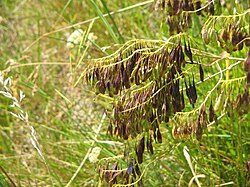 fruits
 -
 fruits (Museum de Toulouse)

.jpg)


- herbacée bisannuelle atteignant 1,5 m de haut
- feuilles entières bleuâtres
- grande panicule de fleurs jaune vif
- fruits : siliques courtes et plates
Noms populaires
| français | pastel, guède |
| anglais | woad |
| allemand | Waid |
| néerlandais | wede |
| italien | guado, gualdo |
| espagnol | yerba pastel |
| catalan | glast, pastell, herba del pastell |
| portugais | pastel |
- Voir les noms dans toutes les langues européennes
- Gaude, woad et l'allemand Waid viennent du germanique. En français, la plante a été appelée pastel parce qu'on broie les feuilles en un pâte ; le mot est languedocien et dérive du latin pasta.
Classification
Isatis tinctoria L. (1753)
C'est une espèce très variable.
Cultivars
Histoire
-
 Sturm, 1796. Deutschlands Flora
 -
 Masclef, 1891, Atlas des plantes de France
 -
 Lindman, 1917-26, Bilder ur Nordens Flora


- Voir la Maison rustique du XIXe siècle, 1837 pour la culture en France.
Usages
- Voir les Plantes médicinales de Cazin (1868)
It was formerly cultivated in large areas of Europe, from Middle East to Afghanistan and N India, Central Asia, Egypt, China, seldom in South America. During the Middle Ages and at the beginning of the Modern Age centres of cultivation were located in S England, S and NW France, Italy (Tuscany) and Germany (Thuringia as well as the lower Rhine area). At that time this species had an international economic importance as a dye plant, the blue dye could be produced from the leaves; it could also be used as an ingredient for certain other colours. Therefore, it was considered in former times as an universal vegetable dye plant. Its cultivation is known from the ancient time, because the Celtic and Teutonic tribes used this species already. After importing the proper indigo (see Indigofera spp.) the cultivation decreased rapidly in the 17th cent. But during the continental embargo of Napoleon I its acreage increased for a short time. The cultivation disappeared completely during the late 19th cent. (also last cultivation in Germany in Thuringia). Large- and glabrous-leaved forms were mainly cultivated. Formerly this plant was also used for medicinal purposes, recently it is propagated in Russia as a forage plant. As a dye plant it is today still cultivated in gardens in central Asia, mainly for preparing home-made cosmetics. Recently cultivation has come into a period of revival in several European countries. From the systematic point of view this species belongs to a very variable group, in which continous variation makes the species delimitation very difficult. It is also not clear whether some of the synonyms represent true species (i.e. I. indigotica) or whether further taxa need to be taken into account. This complex has its centre of diversity from the Middle East to Transcaucasia.
Les feuilles fermentées et pressées en boules appelées cocagnes sont utilisées pour teindre en bleu indigo. Leur usage a beaucoup régressé avec l'arrivée de l'indigo tropical au XVIIe, et disparu avec les teintures industrielles.
Références
- Vaissière Sébastien & Félix Alain, 2006. Le Pastel, Visite en pays de cocagne. Loubatières.
Liens
- BHL
- Bleu de Lectoure (entreprise qui relance la culture)
- FAO Ecocrop
- Grieve's herbal
- GRIN
- IPNI
- Mansfeld
- Plant List
- Plants for a future
- TAXREF
- Tela Botanica
- Wikipédia
- Wikiphyto