« Curcuma longa » : différence entre les versions
Aucun résumé des modifications |
Aucun résumé des modifications |
||
| (13 versions intermédiaires par le même utilisateur non affichées) | |||
| Ligne 6 : | Ligne 6 : | ||
|famille = Zingiberaceae | |famille = Zingiberaceae | ||
|genre = Curcuma | |genre = Curcuma | ||
|nb chromosomes = 2n = | |nb chromosomes = 2n = 3x = 63 | ||
|origine = | |origine = Inde, Sri Lanka, est de l’Himalaya | ||
|statut = | |statut = triploïde cultivé | ||
|français = '''curcuma''' | |français = '''curcuma''' | ||
|anglais = '''turmeric''' | |anglais = '''turmeric''' | ||
| Ligne 16 : | Ligne 16 : | ||
|texte=*épice (rhizome) | |texte=*épice (rhizome) | ||
*colorant (rhizome) | *colorant (rhizome) | ||
*médicinal | |||
}} | }} | ||
== Description == | == Description == | ||
<gallery mode="packed"> | <gallery mode="packed"> | ||
Curcuma longa MC.tif|1, port de la plante ; 2, rhizome (PROSEA, P. Verheij-Hayes) | |||
File:Curcuma_longa_2.jpg|plante en fleurs (B. Loison, mytho-fleurs.com) | File:Curcuma_longa_2.jpg|plante en fleurs (B. Loison, mytho-fleurs.com) | ||
File:Curcuma longa 001.JPG|inflorescence | File:Curcuma longa 001.JPG|inflorescence | ||
| Ligne 35 : | Ligne 35 : | ||
{| class="wikitable" style="width:100%;" | {| class="wikitable" style="width:100%;" | ||
| français | | français | ||
| curcuma | | curcuma ; safran des Indes, safran pays (Réunion), safran couli (Antilles) | ||
|- | |||
| créole guyanais | |||
| safra [safra] (Guyane) (Pharma. Guyane) | |||
|- | |||
| créole antillais | |||
| titima, chichima [chichima] (Pharma. Guyane) | |||
|- | |||
| palikur | |||
| saβga (Pharma. Guyane) | |||
|- | |- | ||
| anglais | | anglais | ||
| turmeric | | turmeric | ||
|- | |||
| allemand | |||
| Gelbwurzel | |||
|- | |||
| néerlandais | |||
| kurkuma, koenjit, geelwortel | |||
|- | |||
| italien | |||
| zafferano d’Oriente, terramerita | |||
|- | |||
| espagnol | |||
| cúrcuma, azafrán de la Índia | |||
|- | |- | ||
| portugais | | portugais | ||
| curcuma, rizoma dos Índios, açafroeira da Índia, terra merita | | curcuma, rizoma dos Índios, açafroeira da Índia, açafrão da India, terra merita, croco indiano | ||
|- | |- | ||
| swahili | | swahili | ||
| mmanjano | | mmanjano (PROTA) | ||
|- | |||
| hindi | |||
| haldī | |||
|- | |||
| Philippines | |||
| dilaw (tagalog), duwaw (cebuano), kalawag (ilocano), kalabaga (bisaya), kunik (ibanag) | |||
|- | |||
| Brunei | |||
| kunyit, temu kuning, temu kunyit (dusun, malais) (PROSEA) | |||
|- | |||
| Indonésie | |||
| kunyit (indonésien), kunir (javanais), koneng (sundanais) (PROSEA) | |||
|- | |||
| Malaysia | |||
| kunyit, temu kunyit (malais) ; tius (Semang) (PROSEA) | |||
|- | |||
| Papouasie-Nouvelle-Guinée | |||
| kawawara, lavar, tamaravirua (Gunantuna, New Britain) (PROSEA) | |||
|- | |||
| Thaïlande | |||
| khamin (général), khamin-kaeng (nord), khamin-chan (centre) (PROSEA) | |||
|- | |||
| Vietnam | |||
| nghệ, nghệ vàng, uất kim (PROSEA) | |||
|- | |||
| Laos | |||
| khi min, 'khmin<sup>2</sup>'khun<sup>2</sup> (PROSEA) | |||
|- | |||
| Cambodge | |||
| rômiêt, lômiêt (PROSEA) | |||
|- | |||
| Birmanie | |||
| nanwin (PROSEA) | |||
|} | |} | ||
| Ligne 50 : | Ligne 104 : | ||
''Curcuma longa'' L. (1753) | ''Curcuma longa'' L. (1753) | ||
synonymes : | |||
*''Amomum curcuma'' Jacq. (1776) | |||
*''Curcuma domestica'' Valeton (1918) | *''Curcuma domestica'' Valeton (1918) | ||
*''Curcuma soloensis'' Valeton (1918) | |||
== Cultivars == | == Cultivars == | ||
| Ligne 59 : | Ligne 115 : | ||
File:Curcuma longa - Köhler–s Medizinal-Pflanzen-199.jpg|Köhler, 1897. ''Medizinal-Pflanzen'' | File:Curcuma longa - Köhler–s Medizinal-Pflanzen-199.jpg|Köhler, 1897. ''Medizinal-Pflanzen'' | ||
</gallery> | </gallery> | ||
*Voir [[Korkom (Ibn al-Baytar)|Korkom (''Traité des simples'', Ibn al-Baytar, XIIIe)]] | |||
== Usages == | == Usages == | ||
*Voir les [[Zingibéracées (Petelot)#Curcuma longa|''Plantes médicinales du Cambodge, du Laos et du Viêtnam'' de Petelot (1952-1954)]] | *Voir les [[Zingibéracées (Petelot)#Curcuma longa|''Plantes médicinales du Cambodge, du Laos et du Viêtnam'' de Petelot (1952-1954)]] | ||
*[https://www.anses.fr/fr/content/des-effets-ind%C3%A9sirables-li%C3%A9s-%C3%A0-la-consommation-de-compl%C3%A9ments-alimentaires-contenant-du Des effets indésirables liés à la consommation de compléments alimentaires contenant du curcuma] (ANSES, 27/06/2022). Cette annonce concerne les formulations industrielles qui augmentent la biodisponibilité de la curcumine. Elle ne concerne pas l'épice. | |||
{{Citation encadré | |||
|texte= In the tropics widely cultivated (the largest producer is India). The rhizome yields an important spice, used in diverse foods and dishes (also as a condiment in curry-powder). A yellow dye, obtained from the rhizome, serves the dyeing of foods, wool, cotton, and silk. From the rhizomes also an essential oil is extracted by distillation.The young shoots and rhizome tips are eaten raw. In addition, the rhizomes are utilized for medicinal and cosmetic purposes. Also the leaves are used as spice and perfume. Wild distribution: India, Sri Lanka, SE Asia. | |||
|auteur =Mansfeld. | |||
}} | |||
Le colorant est orange en milieu basique, et jaune en milieu acide (donc dans les moutardes et pickles). | |||
== Références == | == Références == | ||
*Burtt, B. L. 1977. The nomenclature of turmeric and other Ceylon ''Zingiberaceae''. ''Notes Roy. Bot. Gard. Edinburgh'', 35: 212. | *Burtt, B. L. 1977. The nomenclature of turmeric and other Ceylon ''Zingiberaceae''. ''Notes Roy. Bot. Gard. Edinburgh'', 35: 212. | ||
*Chauvet, Michel, 2018. ''[[Encyclopédie des plantes alimentaires]]''. Paris, Belin. 880 p. (p. 787) | |||
*Dambourney, Louis-Alexandre, 1786. ''Recueil de procédés et d'expériences sur les teintures solides que nos végétaux indigènes communiquent aux laines & aux lainages.'' Paris, De l'imprimerie de Ph.-D. Pierres, premier imprimeur ordinaire du roi. 407 p. [[C (Recueil de Dambourney)#CURCUMA|Voir sur Pl@ntUse]] | |||
*Fine, Julia, 2021. ''Turmeric: Herb of the Sun''. Dumbarton Oaks. [https://lab.planthumanities.org/turmeric/ Plant Humanities] | *Fine, Julia, 2021. ''Turmeric: Herb of the Sun''. Dumbarton Oaks. [https://lab.planthumanities.org/turmeric/ Plant Humanities] | ||
*Grenand, Pierre ; Moretti, Christian ; Jacquemin, Henri & Prévost, Marie-Françoise, 2004. ''Pharmacopées traditionnelles en Guyane. Créoles, Wayãpi, Palikur''. 2e édition revue et complétée. Paris, IRD. 816 p. (1ère éd.: 1987). [[Curcuma longa (Pharmacopées en Guyane)|Voir sur Pl@ntUse]]. | |||
*Guthrie, William Bruce, 2009. The trade-language origin of "turmeric". ''Word'', '''60''' (1) : 79-90. [https://doi.org/10.1080/00437956.2009.11432594 doi : 10.1080/00437956.2009.11432594]. Pour l'auteur, turmeric ne vient pas de terre mérite, mais d'un mot afghan ou proche, tzer-merich, où merich signifie "poivre". | *Guthrie, William Bruce, 2009. The trade-language origin of "turmeric". ''Word'', '''60''' (1) : 79-90. [https://doi.org/10.1080/00437956.2009.11432594 doi : 10.1080/00437956.2009.11432594]. Pour l'auteur, turmeric ne vient pas de terre mérite, mais d'un mot afghan ou proche, tzer-merich, où merich signifie "poivre". | ||
*TRAMIL, ''Pharmacopée végétale caribéenne'', éd. scient. L. Germosén-Robineau. 2014. 3e éd. Santo Domingo, Canopé de Guadeloupe. 420 p. Voir sur [[Curcuma longa (TRAMIL)|Pl@ntUse]] | *TRAMIL, ''Pharmacopée végétale caribéenne'', éd. scient. L. Germosén-Robineau. 2014. 3e éd. Santo Domingo, Canopé de Guadeloupe. 420 p. Voir sur [[Curcuma longa (TRAMIL)|Pl@ntUse]] | ||
| Ligne 71 : | Ligne 139 : | ||
== Liens == | == Liens == | ||
*[http://www.biodiversitylibrary.org/search.aspx?SearchTerm=Curcuma%20longa&SearchCat= BHL] | *[http://www.biodiversitylibrary.org/search.aspx?SearchTerm=Curcuma%20longa&SearchCat= BHL] | ||
*[http://gernot-katzers-spice-pages.com/engl/Curc_lon.html Gernot Katzer's Spice pages] | *[http://gernot-katzers-spice-pages.com/engl/Curc_lon.html Gernot Katzer's Spice pages] | ||
*[http://botanical.com/botanical/mgmh/t/turmer30.html Grieve's herbal] | *[http://botanical.com/botanical/mgmh/t/turmer30.html Grieve's herbal] | ||
*[https://npgsweb.ars-grin.gov/gringlobal/taxonomydetail.aspx?id=12676 GRIN] | *[https://npgsweb.ars-grin.gov/gringlobal/taxonomydetail.aspx?id=12676 GRIN] | ||
*[http://www.ipni.org/ipni/simplePlantNameSearch.do?find_wholeName=Curcuma%20longa&output_format=normal&query_type=by_query&back_page=query_ipni.html IPNI] | *[http://www.ipni.org/ipni/simplePlantNameSearch.do?find_wholeName=Curcuma%20longa&output_format=normal&query_type=by_query&back_page=query_ipni.html IPNI] | ||
*[ | *[https://mansfeld.ipk-gatersleben.de/apex/f?p=185:46:7366435519921::NO::module,mf_use,source,akzanz,rehm,akzname,taxid:mf,,botnam,0,,Curcuma%20longa,3244 Mansfeld] | ||
*[http:// | *[http://naeb.brit.org/uses/search/?string=Curcuma+longa Moerman, Native American Ethnobotany] | ||
*[http://www.plantnames.unimelb.edu.au/Sorting/Curcuma.html Multilingual Plant Name Database] | *[http://www.plantnames.unimelb.edu.au/Sorting/Curcuma.html Multilingual Plant Name Database] | ||
*[https://hort.purdue.edu/newcrop/Crops/Tumeric.html NewCrop Purdue] | *[https://hort.purdue.edu/newcrop/Crops/Tumeric.html NewCrop Purdue] | ||
*[http://www.theplantlist.org/tpl1.1/search?q=Curcuma+longa Plant List] | *[http://www.theplantlist.org/tpl1.1/search?q=Curcuma+longa Plant List] | ||
*[[:en:Curcuma longa (PROSEA)|PROSEA | *[https://powo.science.kew.org/taxon/urn:lsid:ipni.org:names:796451-1 Plants of the World Online] | ||
*PROSEA sur Pl@ntUse : [[:en:Curcuma longa (PROSEA)|''Curcuma longa'']] et [[:en:Curcuma soloensis (PROSEA)|''Curcuma soloensis'']] | |||
*[[Curcuma longa (PROTA)|PROTA sur Pl@ntUse]] | *[[Curcuma longa (PROTA)|PROTA sur Pl@ntUse]] | ||
*[ | *[https://www.tela-botanica.org/apd-nn-20253 Tela Botanica] | ||
*[http://tropical.theferns.info/viewtropical.php?id=Curcuma%20longa Useful Tropical Plants Database] | *[http://tropical.theferns.info/viewtropical.php?id=Curcuma%20longa Useful Tropical Plants Database] | ||
*[https://fr.wikipedia.org/wiki/Curcuma%20longa Wikipédia] | *[https://fr.wikipedia.org/wiki/Curcuma%20longa Wikipédia] | ||
*[http://www.wikiphyto.org/wiki/Curcuma%20longa Wikiphyto] | *[http://www.wikiphyto.org/wiki/Curcuma%20longa Wikiphyto] | ||
*[http://www.worldfloraonline.org/taxon/wfo-0000365771 World Flora Online] | |||
[[Category:Curcuma]] | [[Category:Curcuma]] | ||
[[Catégorie:Médecine humaine, tropical secondaire]] | |||
Dernière version du 16 septembre 2022 à 15:51
Curcuma longa L.

| Ordre | Zingiberales |
|---|---|
| Famille | Zingiberaceae |
| Genre | Curcuma |
2n = 3x = 63
Origine : Inde, Sri Lanka, est de l’Himalaya
triploïde cultivé
| Français | curcuma |
|---|---|
| Anglais | turmeric |
- épice (rhizome)
- colorant (rhizome)
- médicinal
Description
-
1, port de la plante ; 2, rhizome (PROSEA, P. Verheij-Hayes)
-
 plante en fleurs (B. Loison, mytho-fleurs.com)
 -
 inflorescence
 -
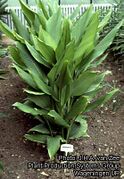 port de la plante
 -
 touffe de rhizomes
 -
 rhizomes (Kazuo Yamasaki)
 -
 rhizome et racines adhérentes
 -
 poudre de curcuma en vente au marché de Limbe, Malawi
 -
 champ au Tamil-Nadu, Inde
 -
 récolte au Maharashtra, Inde


Noms populaires
| français | curcuma ; safran des Indes, safran pays (Réunion), safran couli (Antilles) |
| créole guyanais | safra [safra] (Guyane) (Pharma. Guyane) |
| créole antillais | titima, chichima [chichima] (Pharma. Guyane) |
| palikur | saβga (Pharma. Guyane) |
| anglais | turmeric |
| allemand | Gelbwurzel |
| néerlandais | kurkuma, koenjit, geelwortel |
| italien | zafferano d’Oriente, terramerita |
| espagnol | cúrcuma, azafrán de la Índia |
| portugais | curcuma, rizoma dos Índios, açafroeira da Índia, açafrão da India, terra merita, croco indiano |
| swahili | mmanjano (PROTA) |
| hindi | haldī |
| Philippines | dilaw (tagalog), duwaw (cebuano), kalawag (ilocano), kalabaga (bisaya), kunik (ibanag) |
| Brunei | kunyit, temu kuning, temu kunyit (dusun, malais) (PROSEA) |
| Indonésie | kunyit (indonésien), kunir (javanais), koneng (sundanais) (PROSEA) |
| Malaysia | kunyit, temu kunyit (malais) ; tius (Semang) (PROSEA) |
| Papouasie-Nouvelle-Guinée | kawawara, lavar, tamaravirua (Gunantuna, New Britain) (PROSEA) |
| Thaïlande | khamin (général), khamin-kaeng (nord), khamin-chan (centre) (PROSEA) |
| Vietnam | nghệ, nghệ vàng, uất kim (PROSEA) |
| Laos | khi min, 'khmin2'khun2 (PROSEA) |
| Cambodge | rômiêt, lômiêt (PROSEA) |
| Birmanie | nanwin (PROSEA) |
Classification
Curcuma longa L. (1753)
synonymes :
- Amomum curcuma Jacq. (1776)
- Curcuma domestica Valeton (1918)
- Curcuma soloensis Valeton (1918)
Cultivars
Histoire
-
 Köhler, 1897. Medizinal-Pflanzen

Usages
- Des effets indésirables liés à la consommation de compléments alimentaires contenant du curcuma (ANSES, 27/06/2022). Cette annonce concerne les formulations industrielles qui augmentent la biodisponibilité de la curcumine. Elle ne concerne pas l'épice.
In the tropics widely cultivated (the largest producer is India). The rhizome yields an important spice, used in diverse foods and dishes (also as a condiment in curry-powder). A yellow dye, obtained from the rhizome, serves the dyeing of foods, wool, cotton, and silk. From the rhizomes also an essential oil is extracted by distillation.The young shoots and rhizome tips are eaten raw. In addition, the rhizomes are utilized for medicinal and cosmetic purposes. Also the leaves are used as spice and perfume. Wild distribution: India, Sri Lanka, SE Asia.
Le colorant est orange en milieu basique, et jaune en milieu acide (donc dans les moutardes et pickles).
Références
- Burtt, B. L. 1977. The nomenclature of turmeric and other Ceylon Zingiberaceae. Notes Roy. Bot. Gard. Edinburgh, 35: 212.
- Chauvet, Michel, 2018. Encyclopédie des plantes alimentaires. Paris, Belin. 880 p. (p. 787)
- Dambourney, Louis-Alexandre, 1786. Recueil de procédés et d'expériences sur les teintures solides que nos végétaux indigènes communiquent aux laines & aux lainages. Paris, De l'imprimerie de Ph.-D. Pierres, premier imprimeur ordinaire du roi. 407 p. Voir sur Pl@ntUse
- Fine, Julia, 2021. Turmeric: Herb of the Sun. Dumbarton Oaks. Plant Humanities
- Grenand, Pierre ; Moretti, Christian ; Jacquemin, Henri & Prévost, Marie-Françoise, 2004. Pharmacopées traditionnelles en Guyane. Créoles, Wayãpi, Palikur. 2e édition revue et complétée. Paris, IRD. 816 p. (1ère éd.: 1987). Voir sur Pl@ntUse.
- Guthrie, William Bruce, 2009. The trade-language origin of "turmeric". Word, 60 (1) : 79-90. doi : 10.1080/00437956.2009.11432594. Pour l'auteur, turmeric ne vient pas de terre mérite, mais d'un mot afghan ou proche, tzer-merich, où merich signifie "poivre".
- TRAMIL, Pharmacopée végétale caribéenne, éd. scient. L. Germosén-Robineau. 2014. 3e éd. Santo Domingo, Canopé de Guadeloupe. 420 p. Voir sur Pl@ntUse
Liens
- BHL
- Gernot Katzer's Spice pages
- Grieve's herbal
- GRIN
- IPNI
- Mansfeld
- Moerman, Native American Ethnobotany
- Multilingual Plant Name Database
- NewCrop Purdue
- Plant List
- Plants of the World Online
- PROSEA sur Pl@ntUse : Curcuma longa et Curcuma soloensis
- PROTA sur Pl@ntUse
- Tela Botanica
- Useful Tropical Plants Database
- Wikipédia
- Wikiphyto
- World Flora Online