« Curcuma longa » : différence entre les versions
Aller à la navigation
Aller à la recherche
Aucun résumé des modifications |
Aucun résumé des modifications |
||
| Ligne 7 : | Ligne 7 : | ||
|genre = Curcuma | |genre = Curcuma | ||
|nb chromosomes = 2n = 3x = 63 | |nb chromosomes = 2n = 3x = 63 | ||
|origine = | |origine = Inde, Sri Lanka, est de l’Himalaya | ||
|statut = | |statut = triploïde cultivé | ||
|français = '''curcuma''' | |français = '''curcuma''' | ||
|anglais = '''turmeric''' | |anglais = '''turmeric''' | ||
| Ligne 55 : | Ligne 55 : | ||
|- | |- | ||
| swahili | | swahili | ||
| mmanjano | | mmanjano (PROTA) | ||
|- | |- | ||
| hindi | | hindi | ||
| haldī | | haldī | ||
|- | |||
| Philippines | |||
| dilaw (tagalog), duwaw (cebuano), kalawag (ilocano), kalabaga (bisaya), kunik (ibanag) | |||
|- | |||
| Brunei | |||
| kunyit, temu kuning, temu kunyit (dusun, malais) (PROSEA) | |||
|- | |||
| Indonésie | |||
| kunyit (indonésien), kunir (javanais), koneng (sundanais) (PROSEA) | |||
|- | |||
| Malaysia | |||
| kunyit, temu kunyit (malais) ; tius (Semang) (PROSEA) | |||
|- | |||
| Papouasie-Nouvelle-Guinée | |||
| kawawara, lavar, tamaravirua (Gunantuna, New Britain) (PROSEA) | |||
|- | |||
| Thaïlande | |||
| khamin (général), khamin-kaeng (nord), khamin-chan (centre) (PROSEA) | |||
|- | |||
| Vietnam | |||
| nghệ, nghệ vàng, uất kim (PROSEA) | |||
|- | |||
| Laos | |||
| khi min, 'khmin<sup>2</sup>'khun<sup>2</sup> (PROSEA) | |||
|- | |||
| Cambodge | |||
| rômiêt, lômiêt (PROSEA) | |||
|- | |||
| Birmanie | |||
| nanwin (PROSEA) | |||
|} | |} | ||
Version du 18 mai 2021 à 10:06
Curcuma longa L.

| Ordre | Zingiberales |
|---|---|
| Famille | Zingiberaceae |
| Genre | Curcuma |
2n = 3x = 63
Origine : Inde, Sri Lanka, est de l’Himalaya
triploïde cultivé
| Français | curcuma |
|---|---|
| Anglais | turmeric |
Résumé des usages
- épice (rhizome)
- colorant (rhizome)
Description
-
1, port de la plante ; 2, rhizome (PROSEA)
-
 plante en fleurs (B. Loison, mytho-fleurs.com)
 -
 inflorescence
 -
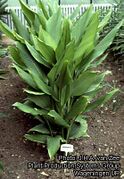 port de la plante
 -
 touffe de rhizomes
 -
 rhizomes (Kazuo Yamasaki)
 -
 rhizome et racines adhérentes
 -
 poudre de curcuma en vente au marché de Limbe, Malawi
 -
 champ au Tamil-Nadu, Inde
 -
 récolte au Maharashtra, Inde


Noms populaires
| français | curcuma ; safran des Indes, safran pays (Réunion), safran couli (Antilles) |
| anglais | turmeric |
| allemand | Gelbwurzel |
| néerlandais | kurkuma, koenjit, geelwortel |
| italien | zafferano d’Oriente, terramerita |
| espagnol | cúrcuma, azafrán de la Índia |
| portugais | curcuma, rizoma dos Índios, açafroeira da Índia, açafrão da India, terra merita, croco indiano |
| swahili | mmanjano (PROTA) |
| hindi | haldī |
| Philippines | dilaw (tagalog), duwaw (cebuano), kalawag (ilocano), kalabaga (bisaya), kunik (ibanag) |
| Brunei | kunyit, temu kuning, temu kunyit (dusun, malais) (PROSEA) |
| Indonésie | kunyit (indonésien), kunir (javanais), koneng (sundanais) (PROSEA) |
| Malaysia | kunyit, temu kunyit (malais) ; tius (Semang) (PROSEA) |
| Papouasie-Nouvelle-Guinée | kawawara, lavar, tamaravirua (Gunantuna, New Britain) (PROSEA) |
| Thaïlande | khamin (général), khamin-kaeng (nord), khamin-chan (centre) (PROSEA) |
| Vietnam | nghệ, nghệ vàng, uất kim (PROSEA) |
| Laos | khi min, 'khmin2'khun2 (PROSEA) |
| Cambodge | rômiêt, lômiêt (PROSEA) |
| Birmanie | nanwin (PROSEA) |
Classification
Curcuma longa L. (1753)
synonymes :
- Amomum curcuma Jacq. (1776)
- Curcuma domestica Valeton (1918)
Cultivars
Histoire
-
 Köhler, 1897. Medizinal-Pflanzen


Usages
Références
- Burtt, B. L. 1977. The nomenclature of turmeric and other Ceylon Zingiberaceae. Notes Roy. Bot. Gard. Edinburgh, 35: 212.
- Chauvet, Michel, 2018. Encyclopédie des plantes alimentaires. Paris, Belin. 880 p. (p. 787)
- Dambourney, Louis-Alexandre, 1786. Recueil de procédés et d'expériences sur les teintures solides que nos végétaux indigènes communiquent aux laines & aux lainages. Paris, De l'imprimerie de Ph.-D. Pierres, premier imprimeur ordinaire du roi. 407 p. Voir sur Pl@ntUse
- Fine, Julia, 2021. Turmeric: Herb of the Sun. Dumbarton Oaks. Plant Humanities
- Guthrie, William Bruce, 2009. The trade-language origin of "turmeric". Word, 60 (1) : 79-90. doi : 10.1080/00437956.2009.11432594. Pour l'auteur, turmeric ne vient pas de terre mérite, mais d'un mot afghan ou proche, tzer-merich, où merich signifie "poivre".
- TRAMIL, Pharmacopée végétale caribéenne, éd. scient. L. Germosén-Robineau. 2014. 3e éd. Santo Domingo, Canopé de Guadeloupe. 420 p. Voir sur Pl@ntUse