Gossypium barbadense
Gossypium barbadense L.
| Ordre | Malvales |
|---|---|
| Famille | Malvaceae |
| Genre | Gossypium |
2n = 52, génome AADD
Origine : Amérique
sauvage ou cultivé
| Français | cotonnier / coton |
|---|---|
| Anglais | cotton |
Résumé des usages
- poils des graines textiles (coton)
- huile des graines alimentaire et industrielle
- médicinal
Description
-
 port de la plante
 -
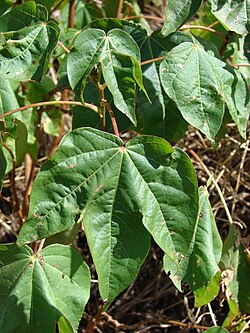 feuilles
 -
 fleur
fleur -
 jeune fruit
.jpg)


Noms populaires
| français | cotonnier / coton ; coton des Indes Occidentales, cotonnier d'Egypte |
| créole guyanais | coton [koton] (Pharma. Guyane) |
| wayãpi | mɨnɨyu, amɨnɨyu (Pharma. Guyane) |
| palikur | mauwu (Pharma. Guyane) |
| aluku | katun (Pharma. Guyane) |
| anglais | sea island cotton, Egyptian cotton, Pima cotton |
| allemand | Baumwolle |
| néerlandais | katoen |
| italien | cotone |
| espagnol | algodonero / algodón |
| portugais | algodoeiro / algodão |
| swahili | pamba (PROTA) |
| Philippines | pernambuko (tagalog, bikol), bulak-kastila (tagalog) (PROSEA) |
| Indonésie | kapas rampit, kapas kayu (PROSEA) |
| Thaïlande | faai chan (Lampang), faai dok (Chiang Mai), faai thet (nord-est) |
| Vietnam | bông hải dảo (PROSEA) |
| Laos | dok foy (PROSEA) |
Classification
Gossypium barbadense L. (1753)
Cultivars
Histoire
-
 Botanical register, 1815
 -
 Köhler, 1897. Medizinal-Pflanzen
_BHL8528.jpg)


Usages
Cultivated in S and Central America; Galapagos Isl., rarely in India and Africa. G. barbadense is an old cultivated species. The annual race, known as "Sea Island" cotton, yields the highest quality lint of any cotton (fibres 3.0-4.0 cm long). Probably the A-genome donor is G. herbaceum and the D-genome donor G. raimondii, a native Peruvian species.
Mansfeld.
Références
- Chauvet, Michel, 2018. Encyclopédie des plantes alimentaires. Paris, Belin. 880 p. (p. 440)
- Grenand, Pierre ; Moretti, Christian ; Jacquemin, Henri & Prévost, Marie-Françoise, 2004. Pharmacopées traditionnelles en Guyane. Créoles, Wayãpi, Palikur. 2e édition revue et complétée. Paris, IRD. 816 p. (1ère éd.: 1987). Voir sur Pl@ntUse.
- TRAMIL, Pharmacopée végétale caribéenne, éd. scient. L. Germosén-Robineau. 2014. 3e éd. Santo Domingo, Canopé de Guadeloupe. 420 p. Voir sur Pl@ntUse