Artemisia dracunculus
Artemisia dracunculus L.

| Ordre | Asterales |
|---|---|
| Famille | Asteracae |
| Genre | Artemisia |
2n = 18, 36, 54, 72, 90
Origine : Russie du Sud,
Asie centrale
sauvage et cultivé
| Français | estragon |
|---|---|
| Anglais | tarragon |
- herbe condimentaire
- arôme du vinaigre
- médicinal
Description
-
 1, port d'une tige en fleurs ; 2, feuilles basales lobées ; 3, capitule ; 4, fleuron femelle ; 5, fleuron mâle (PROSEA)
 -
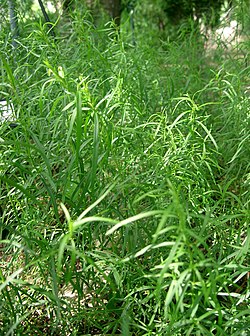 feuilles
 -
 feuilles
 -
 inflorescence


.jpg)
- sous-arbrisseau de 40-150 cm de haut, ramifié, à rhizome ligneux
- feuilles sessiles, les inférieures parfois avec 2-3 lobes, les caulinaires entières, linéaires-lancéolées, de 3-7 cm de long
- panicule ramifiée, ascendante
- capitules penchés, à involucre globuleux de 2-5 mm de diamètre, à bractées à bord scarieux
- 6-10 fleurs ligulées ; 4-14 fleurs tubulées
- akènes obovoïdes (Flora of China)
Le fameux estragon français est stérile, avec 2n = 4x = 36. L'estragon russe est fertile, avec 2n = 10x = 90, et bien moins apprécié ; son goût est différent.
Noms populaires
| français | estragon |
| anglais | tarragon |
| allemand | Estragon, Dragon |
| néerlandais | dragon |
| italien | dragoncello |
| espagnol | estragón, dragoncillo |
| portugais | estragão |
| russe | эстрагон - estragon, тархун - tarhun |
| arabe | طرخون - ṭarẖūn |
| farsi | ترخون - tarẖūn |
| chinois | 龙蒿 - long hao (Flora of China) |
- Voir les noms de la Flore populaire d'Eugène Rolland
- Voir les noms dans toutes les langues européennes
Classification
Artemisia dracunculus L. (1753)
Cultivars
Histoire
-
 Blackwell, 1737, A Curious Herbal 1(2), pl. 116

Usages
-
 boisson pétillante à l'estragon en Géorgie
 -
 tarkhuna, boisson pétillante en Arménie


- Voir les Plantes médicinales de Cazin (1868)
Artemisia dracunculus Linn. TARRAGON. East Europe, the Orient and Himalayan regions. Tarragon was brought to Italy, probably from the shores of the Black Sea, in recent times. The first mention on record is by Simon Seth, in the middle of the twelfth century, but it appears to have been scarcely known as a condiment until the sixteenth century [1]. It was brought to England in or about 1548 [2]. The flowers, as Vilmorin says, are always barren, so that the plant can be propagated only by division. Tarragon culture is mentioned by the botanists of the sixteenth century and in England by Gerarde [3], 1597, and by succeeding authors on gardening. Rauwolf [4], 1573-75, found it in the gardens of Tripoli. In America, it is mentioned by McMahon [5], 1806. Its roots are now included in our leading seed catalogs. Tarragon has a fragrant smell and an aromatic taste for which it is greatly esteemed by the French. In Persia, it has long been customary to use the leaves to create an appetite. Together with the young tips, the leaves are put in salads, in pickles and in vinegar for a fish sauce. They are also eaten with beefsteaks, served with horseradish. Tarragon vinegar, says McIntosh [6], is much esteemed.
Cultivated in Europe, the USA, Brazil, Egypt, India, Indonesia, Zimbabwe and elsewhere. The herbage serves as a flavouring for salads, cucumber and tomato conserves and soups, and for the production of tarragon vinegar. The ethereal oil is used in the production of perfumes. The plant is also used medicinally. The species is represented in cultivation mainly by two polyploid strains, Russian tarragon, a fertile decaploid, and French tarragon, a sterile tetraploid vegetatively propagated. Wild distribution: E and SE Europe, temperate Asia, temperate North America.
Références
- Chauvet, Michel, 2018. Encyclopédie des plantes alimentaires. Paris, Belin. 880 p. (p. 123)
- Chevalier, A. (1943) - Absinthes et armoises cultivées. - Rev. Bot. Appl. Agric. Trop. 23: 308-316.
- Dambourney, Louis-Alexandre, 1786. Recueil de procédés et d'expériences sur les teintures solides que nos végétaux indigènes communiquent aux laines & aux lainages. Paris, De l'imprimerie de Ph.-D. Pierres, premier imprimeur ordinaire du roi. 407 p. Voir sur Pl@ntUse
- Dürbeck, K. (1996) - Die tropischen Verwandten der vier mitteleuropäischen Artemisia-Arten. - - Drogenreport. 9: 47-51.
- Garg, S. & T. S. Sastry (1996): Indian Compositae in foods and flavours - review (pp 361-382) - In: P. D. S. Caligari & D. J. N. Hind (eds.) - Compositae: biology and utilization. Proceedings of the International Compositae Conference, Kew, 1994. 2 Royal Bot. Gardens Kew: 689 p.
- Heeger, E. F. - Handbuch des Arznei- und Gewürzpflanzenbaues: Drogengewinnung. Deutscher Bauernverlag Berlin 1956: 775 p.
- Heinrich, M. (1996): Ethnobotany of Mexican Compositae: an analysis of historical and modern sources (pp 475-503) - In: P. D. S. Caligari & D. J. N. Hind (eds.) - Compositae: biology and utilization. Proceedings of the International Compositae Conference, Kew, 1994. 2 Royal Bot. Gardens Kew: 689 p.
- Huang, Y.-P. & Y.-R. Ling (1996): Economic Compositae in China (pp 431-451) - In: P. D. S. Caligari & D. J. N. Hind (eds.) - Compositae: biology and utilization. Proceedings of the International Compositae Conference, Kew, 1994. 2 Royal Bot. Gardens Kew: 689 pp.
- Madsharova, D. & M. Bubarova (1981) - Gewürzpflanzen in der Ernährung. - Int. Z. Landwirtsch. 25 (6): 555-559.
- Rehm, S. & G. Espig - Die Kulturpflanzen der Tropen und Subtropen: Anbau, wirtschaftliche Bedeutung, Verwertung. (Ulmer Taschenbücher). Ulmer Stuttgart 1976: 496 p.
- Rousi, A., 1969. Cytogenetic comparison between two kinds of cultivated tarragon (Artemisia dracunculus). Hereditas, 62 : 192-193.
- Sampson, H. C. (1936) - Cultivated crop plants of the British Empire and the Anglo-Egyptian Sudan (tropical and subtropical). - - Bull. Misc. Inform., add., Ser. 12. Kew: 251 p.
- Sokolov, P. D. (ed.) - Rastitel'nye resursy SSSR. Semejstva Asteraceae. Nauka Sankt-Peterburg 1993: 352 p.
- Wealth of India. (1948) - The Wealth of India. A dictionary of Indian raw materials and industrial products. - Raw Materials 1 Council Scientific Industrial Research New Delhi.
- Zeven, A. C. & P. M. Zhukovsky - Dictionary of cultivated plants and their centres of diversity. Excluding ornamentals, forest trees and lower plants. Centre for Agricultural Publishing and Documentation Wageningen 1975: 219 p.