Asparagus officinalis
Asparagus officinalis L.
| Ordre | Asparagales |
|---|---|
| Famille | Asparagaceae |
| Genre | Asparagus |
2n = 20, 40
Origine : est de la Méditerranée,
Europe de l'Est, Asie centrale
sauvage ou cultivé
| Français | asperge |
|---|---|
| Anglais | asparagus |
- turions consommés comme légume
- médicinale
Description
-
1, turions naissant de la souche; 2, branches avec cladodes; 3, fleurs; 4, fruits. Source: PROSEA
-
turion sortant de terre
-
fleurs
-
fleur
-
fruits
-
racines
- plante vivace de 50 cm à 1 mètre et plus, glabre, à turions épais et à saveur douce
- tige herbacée, verte, dressée, cylindrique, à rameaux très étalés, lisses
- cladodes filiformes, lisses, mous, fascicules par 3-6 à l'aisselle d'une écaille membraneuse prolongée à la base en éperon très court
- fleurs vert jaunâtre, dioïques, solitaires ou géminées, penchées, à pédoncules articulés vers le milieu, les fructifères à article supérieur un peu plus épais
- anthères oblongues, mutiques, à peine plus courtes que le filet
- baie rouge, de la grosseur d'un pois, à plusieurs graines. (Coste)
Noms populaires
| français | asperge |
| anglais | asparagus |
| allemand | Spargel |
| néerlandais | asperge |
| italien | asparago |
| espagnol | espárrago |
| portugais | espargo |
Classification
Asparagus officinalis L. (1753)
Cultivars
Histoire
-
Spargus. Tacuinum sanitatis. Codex Vindobon. Ser. Nova 2644, XIIIe s., 26v.
-
Thomé, 1885, Flora von Deutschland
-
Flora Batava, 1807, 2.
-
Flora Batava, 1877, 15
-
Masclef, 1891, Atlas des plantes de France
-
Vilmorin-Andrieux, 1904, Les plantes potagères.
-
Vilmorin-Andrieux, 1904, Les plantes potagères.
Usages
-
 asperges blanches
 -
asperges blanches
-
asperges violettes
-
asperges violettes d'Albenga (Italie)
-
asperges vertes
-
 pousses (turions) d’asperges vertes sur le marché
 -
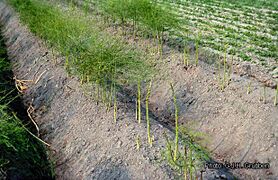 champ, méthode pied-mère
 -
 champ dans les hautes terres du Malawi


.jpg)


- Voir les Plantes médicinales de Cazin (1868)
- Voir les Plantes potagères de Vilmorin (1904)
Asparagus officinalis Linn. ASPARAGUS. Europe, Caucasian regions and Siberia. This plant, so much esteemed in its cultivated state, is a plant of the seashore and river banks of southern Europe and the Crimea. It is now naturalized in many parts of the world. In the southern parts of Russia and Poland, the waste steppes are covered with this plant. Unger [1] says it is not found either wild or cultivated in Greece, but Daubeny [2] says at the present time it is known under the name of asparaggia, and Booth [3] says it is common. Probably the mythological mention of the asparagus thickets which concealed Perigyne, beloved of Theseus,— the plant, in consequence, being protected by law among the lonians inhabiting Caria— referred to another species.
Cultivated asparagus seems to have been unknown to the Greeks of the time of Theophrastus and Disocorides, and the word asparagos seems to have been used for the wild plant of another species. The Romans of the time of Cato, about 200 B. C., knew it well, and Cato's directions for culture would answer fairly well for the gardeners of today, except that he recommends starting with the seed of the wild plant, and this seems good evidence that the wild and the cultivated forms were then of the same type as they are today. Columella [4], in the first century, recommends transplanting the young roots from a seed-bed and devotes some space to their after-treatment. He offers choice of cultivated seed or that from the wild plant, without indicating preference. Pliny [5], who also wrote in the first century, says that asparagus, of all the plants of the garden, receives the most praiseworthy care and also praises the good quality of the kind that grows wild in the island of Nesida near the coast of Campania. In his praise of gardens [6], he says: "Nature has made the asparagus wild, so that any one may gather as found. Behold, the highly-manured asparagus may be seen at Ravenna weighing three pounds." Palladius [7], an author of the third century, rather praises the sweetness of the wild form found growing among the rocks and recommends transplanting it to such places otherwise worthless for agriculture, but he also gives full directions for garden culture with as much care as did Cato. Gesner [8] quotes Pomponius, who lived in the second century, as saying that there are two kinds, the garden and the wild asparagus, and that the wild asparagus is the more pleasant to eat. Suetonius [9], about the beginning of the second century, informs us how partial the Emperor Augustus was to asparagus, and Erasmus [10] also mentions it.
- ↑ Unger, F. U.S. Pat. Off. Rpt. 358. 1859.
- ↑ Daubeny, C. Trees, Shrubs, Anc. 127. 1865.
- ↑ Booth. W. B. Treas. Bot. 1: 101. 1870.
- ↑ Columella lib. 9, c. 3.
- ↑ Bostock and Riley. Nat. Hist. Pliny 4: 188. 1856.
- ↑ Pliny c. 19.
- ↑ Palladius lib. 3, c. 24 ; lib. 4, c. 9.
- ↑ Script. Rei Rust. 1788, Lexicon, art. Asparagus.
- ↑ McIntosh, C. Book Gard. 2: 177. 1855.
- ↑ Ibid.
Widely cultivated in temperate regions of the Old and New World, main centres of asparagus cultivation in S France, the Netherlands and Belgium. Numerous cultivars, less frequently grown in the tropical region (Taiwan). The young sprouts are eaten blanched or unblanched as vegetable. The herb, rhizomes and seeds are used a tonic, antifebrile, anti-rheumatic and diuretic medicine, and in India, an oil is produced from the roots which is laxative and sedative. Saponins extracted from the shoots have been demonstrated to have cancerostatic activity. The fruit are used as diuretic, tonic and aphrodisiac remedy in India. The young shoots contain volatile oil. Sometimes also cultivated as ornamental, e.g. in Cuba. Evidence of use and cultivation can be dated back till antique Roman times. In medieval times, asparagus had been cultivated mainly in monasteries for both medicine and as vegetable. Modern asparagus breeding uses hybrid strategies including in vitro culture, haploid induction and polyploidisation. All-male varieties of higher yield and uniformity can be derived from this dioecious plant by using andromonoecious flowers occuring in several plants or using homozygous parents derived from anther culture. DNA marker techniques have been developed to support the breeding process. Wild distribution: Europe, Near East to Iran, W Siberia, N Africa, also escaped from plantations and naturalized in the Americas and New Zealand. The wild forms are still incompletely investigated.
| Selon TROTTER (1915), on récolte et mange les fleurs de cette espèce.
Pour le Maroc, GATTEFOSSÉ (1945) rapporte de nombreuses indications où entre l'asperge officinale (cultivée en Tunisie) :
La racine, diurétique, entrait dans la composition du « sirop des cinq racines » indiqueunt PARIS et MOYSE (1967) qui ajoutent que les asperges, de saveur agréable, ont une valeur alimentaire assez réduite et peuvent être irritantes pour les reins. En Tunisie, cette vertu diurétique de l'asperge « sakkoum » est confirmée par LEMORDANT et al. (1977). Cette asperge sauvage est utilisée à la campagne pour filtrer, grossièrement, le lait (TROTTER). |
Références
- Brown, W. H. (1951) - Useful plants of the Philippines. 1 - Techn. Bull. 10 Dept. Agric. Nat. Resources Rep. Philippines Manila: 590 p.
- Chauvet, Michel, 2018. Encyclopédie des plantes alimentaires. Paris, Belin. 880 p. (p. 77)
- Doré, C. (1975) - La multiplication clonale de l'asperge (Asparagus officinalis L.) par culture in vitro: Son utilisation en sélection. - Ann. Amélior. Pl. 25 (2): 201-224.
- Drost, D. T. (1997): Asparagus (pp 621-649) - In: H. C. Wien (ed.) - The Physiology of Vegetable Crops CAB International Wallingford: 662 p.
- Fisher, K. J., B. R. MacKay & M. A. Nichols (1996) - The establishment of asparagus clones out of tissue culture - Acta Hort. 415: 249-256.
- Gossweiler, J. (1949) - Flora exótica de Angola. Nomes vulgares e origem das plantas cultivadas ou sub-espontaneâs. - Agron. Angol. 2: 173-263.
- Hammer, K., M. Esquivel & H. Knüpffer (eds.), - "...y tienen faxones y fabas muy diversos de los nuestros." Origin, evolution and diversity of Cuban plant genetic resources. 1-3 IPK Gatersleben 1992-1994: 824 p.
- Harada, T. (1989) - Studies on organogenesis of asparagus (Asparagus officinalis L.) tissues and its utilization. - Mem. Fac. Agric. Hokkaido Univ. 16 (4): 301-346.
- Hondelmann, W. & B. Wilberg (1973) - Breeding allmale-varieties of Asparagus by utilization of anther- and tissue-culture. - Z. Pflanzenzücht. 69: 19-24.
- Khandka, D. K., A. Nejidat & A. Golan-Goldhirsch, (1996) - Polymorphism and DNA markers for asparagus cultivars identified by random amplified polymorphic DNA - Euphytica 87 (1): 39-44.
- Körber-Grohne, U. - Nutzpflanzen in Deutschland. Kulturgeschichte und Biologie., Ed. 3 Theiss Stuttgart 1994: 490 p.
- Roth, L. & K. Kormann - Duftpflanzen und Pflanzendüfte: ätherische Öle und Riechstoffe. ecomed Landsberg 1997: 496 p.
- Rubatzky, V. E. & M. Yamaguchi - World vegetables: principles, production and nutritive values., Ed. 2 Chapman & Hall New York 1997: 843 p.
- Shao, Y., C.-K. Chin, C.-T. Ho, W. Ma, S. A. Garri (1996) - Anti-tumor activity of the crude saponins obtained from asparagus. - Cancer Lett. 104 (1): 31-36.
- Skiebe, K., M. Stein, J. Gottwald & B. Wolterstorf (1991) - Breeding of polyploid asparagus (Asparagus officinalis L.). - Pl. Breed. 106 New York: 99-106.
- Sokolov, P. D. (ed.) - Rastitel'nye resursy Rossii i sopredel'nykh gosudarstv. Cvetkovye rastenija, ich chimičeskij sostav, ispol'zovanie. Semejstva Butomaceae-Typhaceae. Nauka Sankt-Peterburg 1994: 271 p.
- Tindall, H. D. - Commercial vegetable growing. Oxford Univ. Press London-Ibadan-Nairobi 1968: 300 p.
- Vul'f, E. V. & O. F. Maleeva - Mirovye resursy poleznych rastenij (spravočnik). Nauka Leningrad 1969: 566 p.
- Wealth of India. (1948) - The Wealth of India. A dictionary of Indian raw materials and industrial products. - Raw Materials 1 Council Scientific Industrial Research New Delhi.
- Winters, H. F. & G. W. Miskimen (1967) - Vegetable gardening in the Caribbean area. - Agricultural handbook 323 Agric. Res. Serv., U. S. D. A. Washington: 114 p.