« Syzygium malaccense » : différence entre les versions
m →top : clean up |
Aucun résumé des modifications |
||
| (7 versions intermédiaires par le même utilisateur non affichées) | |||
| Ligne 1 : | Ligne 1 : | ||
{{Page espèce (plante à graines) | {{Page espèce (plante à graines) | ||
|image = | |image = Pommerac trinidad.jpg | ||
|légende = | |légende = | ||
|auteur = | |auteur = <br>(L.) Merr. & L. M. Perry | ||
|ordre = | |ordre = Myrtales | ||
|famille = | |famille = Myrtaceae | ||
|genre = | |genre = Syzygium | ||
|nb chromosomes = 2n = | |nb chromosomes = 2n = 22 | ||
|origine = | |origine = Asie du Sud-Est | ||
|statut = sauvage ou cultivé | |statut = sauvage ou cultivé | ||
|français = '''''' | |français = '''jambos''' | ||
|anglais = '''''' | |anglais = '''Malay apple''' | ||
}}{{Encadré | |||
|color=lightgreen | |||
|titre=Résumé des usages | |||
|texte=*bois d'œuvre | |||
*fruit comestible cru ou transformé (gelée, vin) | |||
*fleurs, feuilles et pousses consommées | |||
*ornemental | |||
*brise-vent | |||
*médicinal : écorce, feuilles | |||
}} | }} | ||
== Description == | == Description == | ||
<gallery mode="packed"> | |||
File:Starr-090609-0344-Syzygium malaccense-flowering habit-Haiku-Maui (24667679620).jpg|arbre | |||
File:Syzygium malaccense Maroone 0zz.jpg|feuilles | |||
File:Syzygium malaccense, Mangunharjo Orchard, Dlingo, Yogyakarta.jpg|fleurs | |||
File:Man trang.jpg|fruits blancs | |||
File:Pommerac.cut.jpg|fruit en coupe | |||
</gallery> | |||
== Noms populaires == | == Noms populaires == | ||
{| class="wikitable" style="width:100%;" | {| class="wikitable" style="width:100%;" | ||
| français | |||
| pomme malaque, pomme-Tahiti (Antilles) ; jambos (Réunion) ; pomme d’Haïti, pomme d’amour, pomme de Malaisie, pomme d’eau (Rollet) | |||
|- | |||
| anglais | |||
| Malay apple, pomerac, ohia ; Malay apple (Dominique) ; love apple (Ste-Lucie) ; pomerac (Trinidad, Ste-Lucie) (Rollet) | |||
|- | |||
| allemand | |||
| Wasserapfel | |||
|- | |||
| espagnol | |||
| manzana de agua, manzana malaya, pomarrosa, cajuilito Soliman, pomagás, pomagá, marañón japonés, pomalaca, marañón curazao | |||
|- | |||
| portugais | |||
| jambo vermelho (Brésil) | |||
|- | |||
| créole | |||
| pomm damou (Ste-Lucie) (Rollet) | |||
|- | |||
| Philippines | |||
| yanbu, tersana, makopang-kalabaw (tagalog) (PROSEA) | |||
|- | |||
| Indonésie | |||
| jambu bol (PROSEA) | |||
|- | |||
| Malaysia | |||
| jambu merah, jambu bol (PROSEA) | |||
|- | |||
| Thaïlande | |||
| chomphu-mamieo, chomphu-saraek (centre), chomphu-daeng (PROSEA) | |||
|- | |||
| Vietnam | |||
| cay dao, cay roi (PROSEA) | |||
|- | |||
| Birmanie | |||
| thabyo-thabyay (PROSEA) | |||
|} | |} | ||
== Classification == | == Classification == | ||
''Syzygium malaccense'' (L.) Merr. & L. M. Perry (1938) | |||
basionyme : | |||
*''Eugenia malaccensis'' L. (1753) | |||
== Cultivars == | == Cultivars == | ||
== Histoire == | == Histoire == | ||
<gallery mode="packed"> | |||
File:Hortus Indicus Malabaricus (Fig. 18) BHL463614.jpg|nati-schambu, Rheede, 1678, ''Hortus Malabaricus'', vol. 1, pl. 18 | |||
File:Berthe Hoola van Nooten40.jpg|Berthe Hoola van Nooten, XIXe, ''Fleurs, Fruits et Feuillages Choisis de l'Ile de Java'' | |||
File:Jambosa domestica.jpg|Berthe Hoola van Nooten, XIXe, ''Fleurs, Fruits et Feuillages Choisis de l'Ile de Java'' | |||
</gallery> | |||
== Usages == | == Usages == | ||
{{Citation encadré | |||
|texte=Fruits à saveur acidulée, consommés frais ou cuits ou en conserve dans le sirop. | |||
|auteur=Rollet, 2010. | |||
}} | |||
{{Citation encadré | |||
|texte= Commonly cultivated as fruit-tree, ornamental and wind break in tropical Asia (from India to Indonesia, the Philippines, Vietnam and S China), introduced into E Africa, Nigeria, the Pacific Isl., Central and South America. The ripe fruits are eaten raw or stewed with spices as dessert. Unripe fruits are used for making jelly and pickles. In Puerto Rico it is common to produce table wines from the fruits. In Indonesia the flowers are eaten in salads or are preserved in syrup. Young leaves and shoots are consumed as vegetables. The reddish timber is employed for construction or railway sleepers. Various parts of the plant serve as folk medicine, e.g. for constipation, diabetes, coughs, pulmonary catarrh and headache. There are many cultivars, even some with completely seedless fruits. | |||
|auteur=Mansfeld. | |||
}} | |||
== Références == | == Références == | ||
*Chauvet, Michel, 2018. ''[[Encyclopédie des plantes alimentaires]]''. Paris, Belin. 880 p. (p. 493) | |||
*Elevitch, Craig (ed.), 2006. ''Traditional Trees of Pacific Islands: their culture, environment, and use''. Holualoa, Hawai'i, Permanent Agriculture Resources. 816 p. [https://agroforestry.org/projects/traditional-tree-initiative Agroforestry] [https://agroforestry.org/images/pdfs/Syzygium-Malayapple.pdf télécharger le pdf] | |||
*Orta, Garcia d', 1563. ''Coloquios dos simples, e drogas he cousas mediçinais da India''. Goa, Ioannes de Endem. 250 p. Edité et annoté par Conde de Ficalho en 1891-92. [[Coloquio 28 (Garcia da Orta)|Colloque 28 sur Pl@ntUse]] | |||
*Rollet, Bernard et coll., 2010. ''Arbres des Petites Antilles''. Tome 1 : ''Introduction à la dendrologie''. 276 p. Tome 2 : ''Description des espèces''. 866 p. + 46 pl. coul. + CD de photos sur l'anatomie du bois. Basse-Terre, ONF. Voir [[Syzygium malaccense (Rollet, Antilles)|sur Pl@ntUse]]. | |||
== Liens == | == Liens == | ||
*[http://www.biodiversitylibrary.org/search.aspx?SearchTerm=Syzygium%20malaccense&SearchCat= BHL] | *[http://www.biodiversitylibrary.org/search.aspx?SearchTerm=Syzygium%20malaccense&SearchCat= BHL] | ||
*[http://ecocrop.fao.org/ecocrop/srv/en/cropFindForm FAO Ecocrop] | *[http://ecocrop.fao.org/ecocrop/srv/en/cropFindForm FAO Ecocrop] | ||
*[ | *[https://npgsweb.ars-grin.gov/gringlobal/taxonomydetail.aspx?id=70774 GRIN] | ||
*[http://www.ipni.org/ipni/simplePlantNameSearch.do?find_wholeName=Syzygium%20malaccense&output_format=normal&query_type=by_query&back_page=query_ipni.html IPNI] | *[http://www.ipni.org/ipni/simplePlantNameSearch.do?find_wholeName=Syzygium%20malaccense&output_format=normal&query_type=by_query&back_page=query_ipni.html IPNI] | ||
*[http://mansfeld.ipk-gatersleben.de/ | *[http://mansfeld.ipk-gatersleben.de/apex/f?p=185:46:6602108609169::NO::module,mf_use,source,akzanz,rehm,akzname,taxid:mf,,botnam,0,,Syzygium%20malaccense,12367 Mansfeld] | ||
*[http:// | *[http://naeb.brit.org/uses/search/?string=Syzygium+malaccense Moerman, Native American Ethnobotany] | ||
*[http://www.plantnames.unimelb.edu.au/Sorting/Syzygium.html Multilingual Plant Name Database] | *[http://www.plantnames.unimelb.edu.au/Sorting/Syzygium.html Multilingual Plant Name Database] | ||
*[http://www.hort.purdue.edu/newcrop/nexus/Syzygium_malaccense_nex.html NewCrop Purdue] | *[http://www.hort.purdue.edu/newcrop/nexus/Syzygium_malaccense_nex.html NewCrop Purdue] | ||
*[http://www.theplantlist.org/tpl1.1/search?q=Syzygium+malaccense Plant List] | *[http://www.theplantlist.org/tpl1.1/search?q=Syzygium+malaccense Plant List] | ||
*[[:en:Syzygium aqueum (PROSEA)|PROSEA sur Pl@ntUse]] | *[[:en:Syzygium aqueum (PROSEA)|PROSEA sur Pl@ntUse]] | ||
*[http://tropical.theferns.info/viewtropical.php?id=Syzygium%20malaccense Useful Tropical Plants Database] | *[http://tropical.theferns.info/viewtropical.php?id=Syzygium%20malaccense Useful Tropical Plants Database] | ||
*[https://fr.wikipedia.org/wiki/Syzygium%20malaccense Wikipédia] | *[https://fr.wikipedia.org/wiki/Syzygium%20malaccense Wikipédia] | ||
[[Category:Syzygium]] | |||
Dernière version du 2 juin 2021 à 20:08
Syzygium malaccense
(L.) Merr. & L. M. Perry
| Ordre | Myrtales |
|---|---|
| Famille | Myrtaceae |
| Genre | Syzygium |
2n = 22
Origine : Asie du Sud-Est
sauvage ou cultivé
| Français | jambos |
|---|---|
| Anglais | Malay apple |
- bois d'œuvre
- fruit comestible cru ou transformé (gelée, vin)
- fleurs, feuilles et pousses consommées
- ornemental
- brise-vent
- médicinal : écorce, feuilles
Description
-
arbre
-
feuilles
-
fleurs
-
fruits blancs
-
 fruit en coupe

Noms populaires
| français | pomme malaque, pomme-Tahiti (Antilles) ; jambos (Réunion) ; pomme d’Haïti, pomme d’amour, pomme de Malaisie, pomme d’eau (Rollet) |
| anglais | Malay apple, pomerac, ohia ; Malay apple (Dominique) ; love apple (Ste-Lucie) ; pomerac (Trinidad, Ste-Lucie) (Rollet) |
| allemand | Wasserapfel |
| espagnol | manzana de agua, manzana malaya, pomarrosa, cajuilito Soliman, pomagás, pomagá, marañón japonés, pomalaca, marañón curazao |
| portugais | jambo vermelho (Brésil) |
| créole | pomm damou (Ste-Lucie) (Rollet) |
| Philippines | yanbu, tersana, makopang-kalabaw (tagalog) (PROSEA) |
| Indonésie | jambu bol (PROSEA) |
| Malaysia | jambu merah, jambu bol (PROSEA) |
| Thaïlande | chomphu-mamieo, chomphu-saraek (centre), chomphu-daeng (PROSEA) |
| Vietnam | cay dao, cay roi (PROSEA) |
| Birmanie | thabyo-thabyay (PROSEA) |
Classification
Syzygium malaccense (L.) Merr. & L. M. Perry (1938)
basionyme :
- Eugenia malaccensis L. (1753)
Cultivars
Histoire
-
 nati-schambu, Rheede, 1678, Hortus Malabaricus, vol. 1, pl. 18
 -
Berthe Hoola van Nooten, XIXe, Fleurs, Fruits et Feuillages Choisis de l'Ile de Java
-
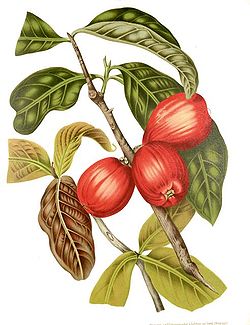 Berthe Hoola van Nooten, XIXe, Fleurs, Fruits et Feuillages Choisis de l'Ile de Java
_BHL463614.jpg)


.jpg)


Usages
Fruits à saveur acidulée, consommés frais ou cuits ou en conserve dans le sirop.
Commonly cultivated as fruit-tree, ornamental and wind break in tropical Asia (from India to Indonesia, the Philippines, Vietnam and S China), introduced into E Africa, Nigeria, the Pacific Isl., Central and South America. The ripe fruits are eaten raw or stewed with spices as dessert. Unripe fruits are used for making jelly and pickles. In Puerto Rico it is common to produce table wines from the fruits. In Indonesia the flowers are eaten in salads or are preserved in syrup. Young leaves and shoots are consumed as vegetables. The reddish timber is employed for construction or railway sleepers. Various parts of the plant serve as folk medicine, e.g. for constipation, diabetes, coughs, pulmonary catarrh and headache. There are many cultivars, even some with completely seedless fruits.
Références
- Chauvet, Michel, 2018. Encyclopédie des plantes alimentaires. Paris, Belin. 880 p. (p. 493)
- Elevitch, Craig (ed.), 2006. Traditional Trees of Pacific Islands: their culture, environment, and use. Holualoa, Hawai'i, Permanent Agriculture Resources. 816 p. Agroforestry télécharger le pdf
- Orta, Garcia d', 1563. Coloquios dos simples, e drogas he cousas mediçinais da India. Goa, Ioannes de Endem. 250 p. Edité et annoté par Conde de Ficalho en 1891-92. Colloque 28 sur Pl@ntUse
- Rollet, Bernard et coll., 2010. Arbres des Petites Antilles. Tome 1 : Introduction à la dendrologie. 276 p. Tome 2 : Description des espèces. 866 p. + 46 pl. coul. + CD de photos sur l'anatomie du bois. Basse-Terre, ONF. Voir sur Pl@ntUse.